Do WhatsApp calls appear on your phone bill?
No — WhatsApp calls never appear as itemised calls on a phone bill, because they are not carrier calls at all; they travel over your internet connection like any other app's traffic. All a bill can show is total data used, aggregated across everything the phone did. It will not name WhatsApp, list who you called, or show how long you talked.
Key takeaways
- No itemisation, ever. There is no number dialled and no duration for a carrier to record.
- Only aggregate data appears, and it is indistinguishable from video streaming or browsing.
- The account holder sees the same thing you do: a data total, with no app breakdown.
- Your own phone does keep a call log inside WhatsApp — that is the record that actually exists.
Why they cannot appear
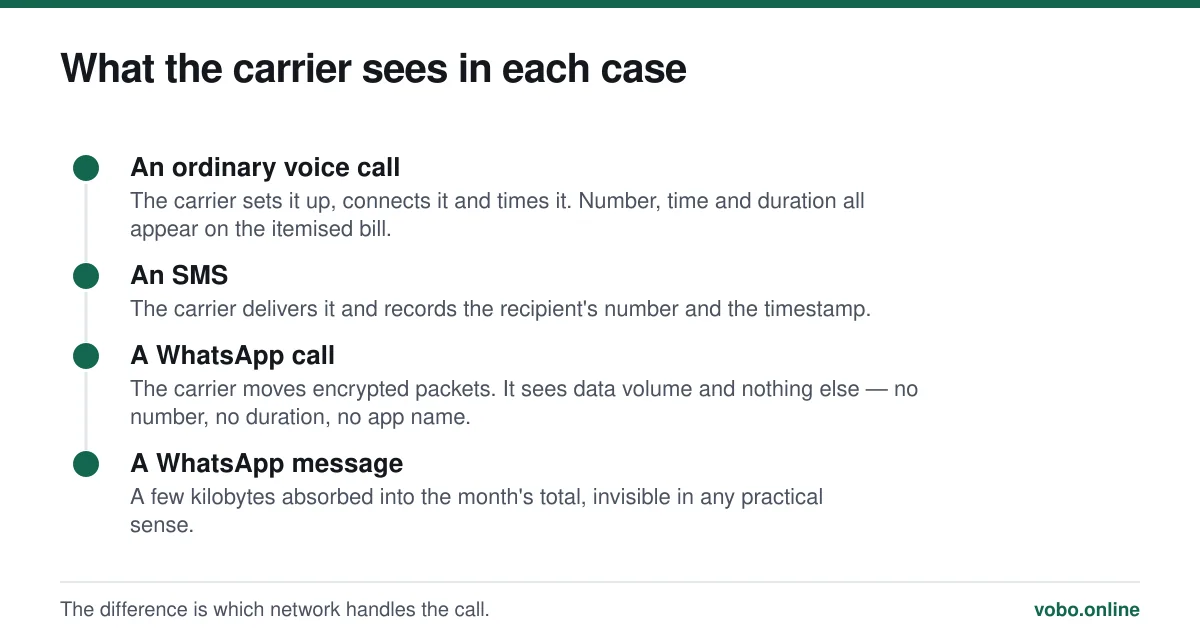
A phone bill itemises things the carrier handled. When you dial a number the normal way, your operator sets up the call, connects it, times it and bills it, so they have a record: the number, the time and the duration.
A WhatsApp call never touches that system. Your phone opens an encrypted internet connection to the other person's phone, and audio flows over it as data packets. To your carrier this looks like any other data traffic — indistinguishable from a video stream or a large download. There is no number dialled, so there is nothing to itemise.
What a bill does show
| Activity | On the bill? | Detail shown |
|---|---|---|
| Standard voice call | Yes | Number called, date, time, duration, cost |
| SMS | Yes | Recipient number, date and time |
| WhatsApp voice or video call | No | Nothing beyond data volume |
| WhatsApp messages | No | Nothing beyond data volume |
| Mobile data overall | Yes | A total in MB or GB, with no breakdown by app |
| Which apps used that data | No | Carriers do not itemise data by application on consumer bills |
Some carriers show data usage broken into daily or session-level chunks. That still tells you nothing about which app was responsible. A large data session on a Tuesday evening is equally consistent with a video call, an hour of streaming, or a system update.
The question behind the question
Most people asking this want to know whether a parent, partner or employer holding the account can see who they have been talking to. The honest answer is that the bill will not tell them, and here is the boundary in detail.
- The account holder sees your itemised carrier calls and texts, including numbers and durations. That has always been true.
- They see your total data consumption for the period, sometimes broken down by day.
- They do not see which apps used the data, who you called on WhatsApp, how long any WhatsApp call lasted, or any message content.
- They cannot obtain WhatsApp records from the carrier, because the carrier does not have them.
What records do exist
- Your own device. WhatsApp keeps a call log under the Calls tab, showing who you called and when. This is the record that actually exists, and it is on your phone.
- The other person's device. They have the mirror image of that log.
- WhatsApp's own metadata. Meta holds records of connection metadata — who contacted whom and when — even though message and call content is end-to-end encrypted and unreadable to them.
- Your device's app-level data usage. iOS and Android both track per-app data use in their own settings. Someone with your unlocked phone can see WhatsApp's total there, though not who you spoke to.
The distinction between content and metadata is the important one, and it runs through most privacy questions about the platform: who owns WhatsApp covers what Meta can and cannot see.
How much data a call actually adds
If the concern is the size of the bill rather than its contents, the figures are modest. A WhatsApp voice call uses roughly 300 KB per minute — about 18 MB an hour. Video is roughly ten times that, at around 3 MB per minute or 180 MB an hour.
So an hour of daily voice calling adds around half a gigabyte a month, which most plans absorb without noticing. An hour of daily video calling adds over five gigabytes, which many plans will not. The full breakdown and the settings that reduce it are in does WhatsApp work without Wi-Fi.
Roaming, where it can cost real money
Abroad and outside your allowance, the data a WhatsApp call consumes is billed at roaming rates. It still will not be itemised as a call, but it can show up as an uncomfortable data charge.
The defence is the ordinary one: use Wi-Fi, turn off media auto-download, and prefer voice to video. What changes abroad is set out in using WhatsApp internationally.
Do not confuse this with Wi-Fi calling
Your phone's own Wi-Fi calling feature routes ordinary carrier calls over Wi-Fi when the mobile signal is weak. Those are still carrier calls: they use your minutes and they appear on the itemised bill exactly as normal.
This gets conflated with WhatsApp calling constantly, usually by someone concluding that a WhatsApp call has used their minutes. It has not. The two are unrelated systems that happen to both involve Wi-Fi.
Frequently asked questions
Can my parents see my WhatsApp calls on the phone bill?
No. The bill shows itemised carrier calls and texts plus a total data figure. WhatsApp calls are not itemised anywhere on it, and the data total gives no indication of which app used it.
Can my employer see my WhatsApp use on a work phone?
Not from the bill. They may be able to see far more through mobile device management software installed on a company handset, which can log installed apps and, on some configurations, more than that. That is a device question, not a billing one.
Do WhatsApp calls use minutes?
No. They use data. Your plan minutes are for carrier voice calls, and WhatsApp never places one. This is why a two-hour WhatsApp call to another country costs nothing beyond the data it consumed.
Can police obtain my WhatsApp call records?
Not from your carrier, which does not have them. With appropriate legal process they can request metadata from Meta — records of connections and timings — but not message or call content, which is end-to-end encrypted and unreadable to Meta.
Sources
- About voice and video calls — WhatsApp Help CenterSupports: That WhatsApp calls use the internet connection rather than the carrier voice network, which is why they cannot be itemised.
- How to manage storage and data usage — WhatsApp Help CenterSupports: The 'use less data for calls' setting and WhatsApp's own data-usage reporting used for the per-minute figures.
- WhatsApp Privacy Policy — WhatsApp LLCSupports: What connection and usage metadata WhatsApp retains, as distinct from message content which it cannot read.
Related reading
Calls, data and cost
Does WhatsApp work without Wi-Fi? Yes — and here is what it costs
WhatsApp works on mobile data with no Wi-Fi at all. This explains what it needs, how much data messages and calls actually use, and what breaks offline.
Calls, data and cost
Is WhatsApp free? Yes, and here is what it actually costs you
WhatsApp costs nothing to install or use, and has since 2016. The real costs are data, roaming and what Meta gets from your metadata.
Calls, data and cost
Does WhatsApp work internationally, and what does it cost abroad?
WhatsApp works in almost every country with no extra charge, because messages travel over the internet. Here is what changes abroad and where it is blocked.
Privacy and security
Can WhatsApp be hacked? What is actually possible, and what is marketing
Almost every 'WhatsApp hacking' claim is false. Here is what can genuinely compromise an account, how to spot it, and how to lock the account down.