Is WhatsApp free? Yes, and here is what it actually costs you
Yes. WhatsApp is free to download and free to use, with no subscription, no per-message charge and no per-minute charge for calls — though until 2016 it did cost about $0.99 a year in some markets. The costs that remain are indirect: the mobile data it consumes, and what Meta gains from the metadata it collects.
Key takeaways
- There is no subscription. The $0.99 annual fee was abolished in January 2016 and has not returned.
- Calls use no minutes and cost nothing beyond data — roughly 300 KB per minute for voice.
- Businesses do pay. WhatsApp Business Platform charges companies to message customers, which is where the revenue comes from.
- Any message telling you WhatsApp is about to start charging is a hoax, and has been circulating since 2012.
The direct answer
Downloading WhatsApp costs nothing. Using it costs nothing. There is no premium tier, no paid feature set, no message limit you can pay to lift, and no charge for calls of any length to any country.
The only thing you spend is data, and only when you are not on Wi-Fi. Text messages consume so little of it that a heavy texter will not notice; photos, voice notes and especially video calls are where a data allowance actually goes.
It used to cost 99 cents
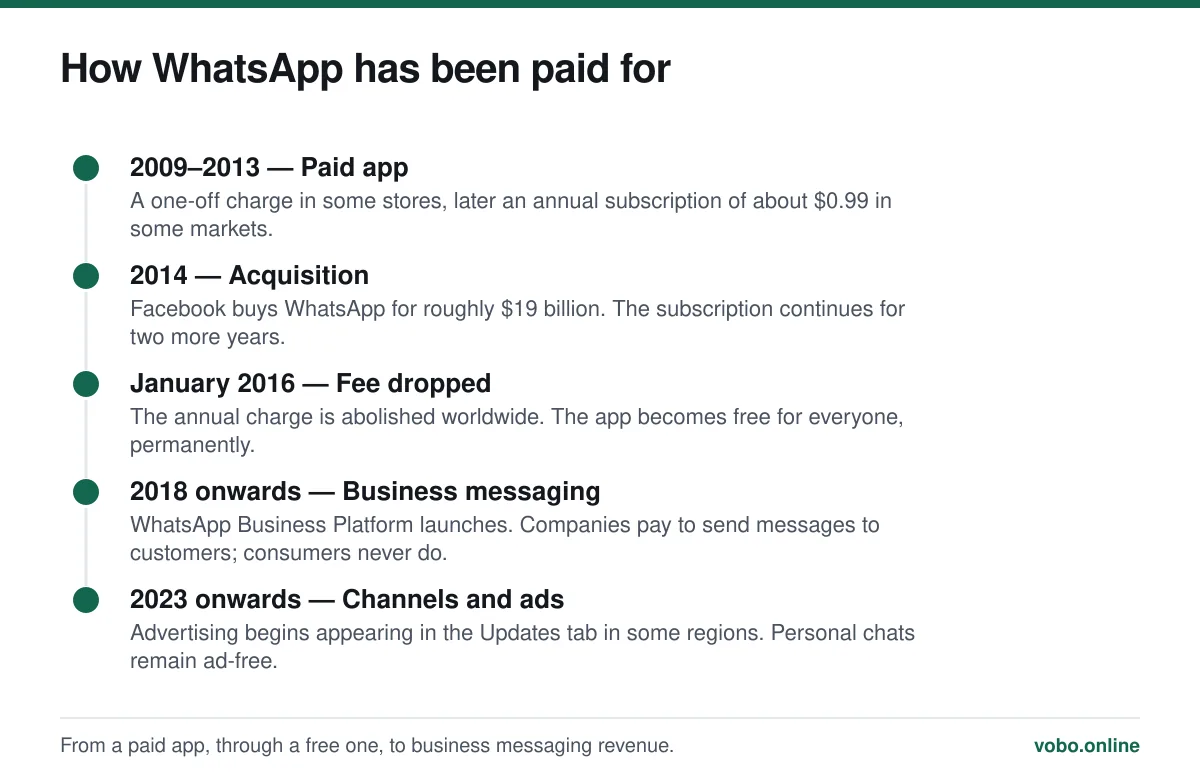
This is the source of most of the confusion, and of the recurring hoax messages. WhatsApp originally charged a small annual subscription — around $0.99 a year, applied inconsistently across markets and often after a free first year. The founders chose that model specifically so the app would not need advertising.
In January 2016 WhatsApp dropped the fee entirely, saying it did not work well for people without payment cards and that it created a barrier for exactly the users who most needed the service. Nobody has been charged since.
The 'WhatsApp is going to start charging' hoax
You will have seen it: a forwarded message claiming WhatsApp is becoming a paid service, and that forwarding the message to ten contacts will keep your account free, or turn your tick blue, or similar. Versions of this have circulated since roughly 2012, updated with new dates and new details but structurally identical.
It is always false. WhatsApp does not announce pricing through forwarded chain messages, and forwarding anything to anyone has never changed the status of an account. The tell is the instruction to forward — a real announcement would not need you to distribute it.
What it does cost you
| Cost | Who pays | How much |
|---|---|---|
| Mobile data | You, via your data plan | About 300 KB per minute of voice call; text is negligible |
| Roaming data | You, if abroad outside your allowance | Potentially significant — a video call can run to megabytes per minute |
| Your metadata | You, non-monetarily | Who you message, when, from where and on what device |
| Business messages | Companies, per conversation | Nothing to you as the recipient |
| Advertising | Advertisers | Ads appear in the Updates tab in some regions, not in personal chats |
The data figures matter most for people on metered or prepaid plans, and the exact numbers with ways to cut them are in does WhatsApp work without Wi-Fi. The metadata question — what Meta can and cannot see — is covered in who owns WhatsApp.
Are the calls really free?
Yes, in the sense that matters: they consume no minutes from your plan, incur no per-minute charge, and cost nothing extra when the person is in another country. A three-hour call to Sydney costs the same as a three-minute call next door.
Two caveats worth knowing. First, they use data, so on a roaming connection outside your allowance they are not free at all. Second, some carriers exclude VoIP calls from 'unlimited social media' bundles that do include WhatsApp messaging — the app gives you no warning when you cross that line, because it does not know where the line is.
Because they are internet calls rather than carrier calls, they also never appear as itemised entries on a bill. That question comes up constantly and is answered in do WhatsApp calls appear on your phone bill.
Who actually pays for WhatsApp
Businesses. WhatsApp's revenue comes primarily from the Business Platform, where companies pay to send messages to customers — order confirmations, delivery updates, appointment reminders and marketing. Pricing is per conversation and varies by country and message category.
The small WhatsApp Business app, aimed at sole traders and small shops, is free. It is the large-scale API access that costs money. From your side as a consumer, receiving a message from a business costs you nothing beyond the data.
Things that are not hidden charges
- The six-digit verification code. Receiving an SMS is free on essentially every plan. See what the code is for.
- Backups. iCloud and Google Drive backups may count against those services' storage limits, which you may already pay for, but WhatsApp charges nothing for the backup itself.
- Linked devices. Using WhatsApp on a laptop or tablet is free and included.
- Channels. Following a channel is free; some channel operators may sell things elsewhere, but the following itself is not charged.
Frequently asked questions
Does WhatsApp cost money after a year?
No. That was true before January 2016, when a roughly $0.99 annual subscription applied in some markets. The fee was abolished worldwide and has not returned. Nobody is charged for a personal WhatsApp account today.
Is WhatsApp calling free?
There is no charge from WhatsApp and it uses no plan minutes. It consumes data at roughly 300 KB per minute for voice, so it is free on Wi-Fi or an unlimited plan and costs whatever data costs otherwise.
Does my carrier charge extra for WhatsApp?
Not as a separate line item. WhatsApp is ordinary data traffic to your carrier. Some plans zero-rate WhatsApp messaging while excluding its voice and video calls, so check your plan's small print if you make long calls on mobile data.
Will WhatsApp start charging in the future?
Nothing announced suggests so, and the business model has moved decisively toward charging companies rather than consumers. Any specific claim that charging is about to start, particularly one arriving as a forwarded message, is a hoax that has circulated in various forms since 2012.
Sources
- WhatsApp Blog — WhatsAppSupports: WhatsApp's own announcements, including the removal of the annual subscription fee in January 2016.
- About voice and video calls — WhatsApp Help CenterSupports: That calls use the internet connection and consume data rather than plan minutes, so there is no per-minute charge.
Related reading
Calls, data and cost
Does WhatsApp work without Wi-Fi? Yes — and here is what it costs
WhatsApp works on mobile data with no Wi-Fi at all. This explains what it needs, how much data messages and calls actually use, and what breaks offline.
Calls, data and cost
Do WhatsApp calls appear on your phone bill?
WhatsApp calls are never itemised on a phone bill because they are not carrier calls. Here is what a bill can and cannot reveal about your WhatsApp use.
Privacy and security
Who owns WhatsApp, and what that ownership actually means for you
Meta Platforms has owned WhatsApp since 2014, when Facebook paid about $19 billion for it. Here is how that happened and what changed for users afterwards.
Calls, data and cost
Does WhatsApp work internationally, and what does it cost abroad?
WhatsApp works in almost every country with no extra charge, because messages travel over the internet. Here is what changes abroad and where it is blocked.