Who owns WhatsApp, and what that ownership actually means for you
WhatsApp is owned by Meta Platforms, Inc., the company called Facebook, Inc. until October 2021. Facebook agreed to buy it in February 2014 in a deal ultimately worth roughly $19 billion, and both founders left within a few years over disagreements about advertising and data. It has not been an independent company since.
Key takeaways
- Meta Platforms owns WhatsApp outright. It is a product, not a subsidiary with independent governance.
- The February 2014 deal was announced at about $16 billion and closed at roughly $19 billion once share price movement and restricted stock were counted.
- Both founders left — Brian Acton in 2017, Jan Koum in 2018 — and Acton later publicly encouraged people to delete Facebook.
- Message content is end-to-end encrypted and Meta cannot read it. Metadata about who you talk to, and when, is a different matter entirely.
The direct answer
WhatsApp Inc. — now WhatsApp LLC — is a wholly owned part of Meta Platforms, Inc., the American company headquartered in Menlo Park, California. Meta also owns Facebook, Instagram, Messenger, Threads and Reality Labs. If you use WhatsApp, your account exists inside Meta's infrastructure, governed by Meta's policies, subject to Meta's decisions about the product.
That is worth stating plainly because a surprising number of people still believe WhatsApp is independent. It has not been for over a decade. The confusion is understandable: WhatsApp kept its own name, its own app, its own green branding and, for a long time, a deliberately separate public identity. Meta only began adding "from Meta" to the app's splash screen in 2021.
How the 2014 acquisition happened
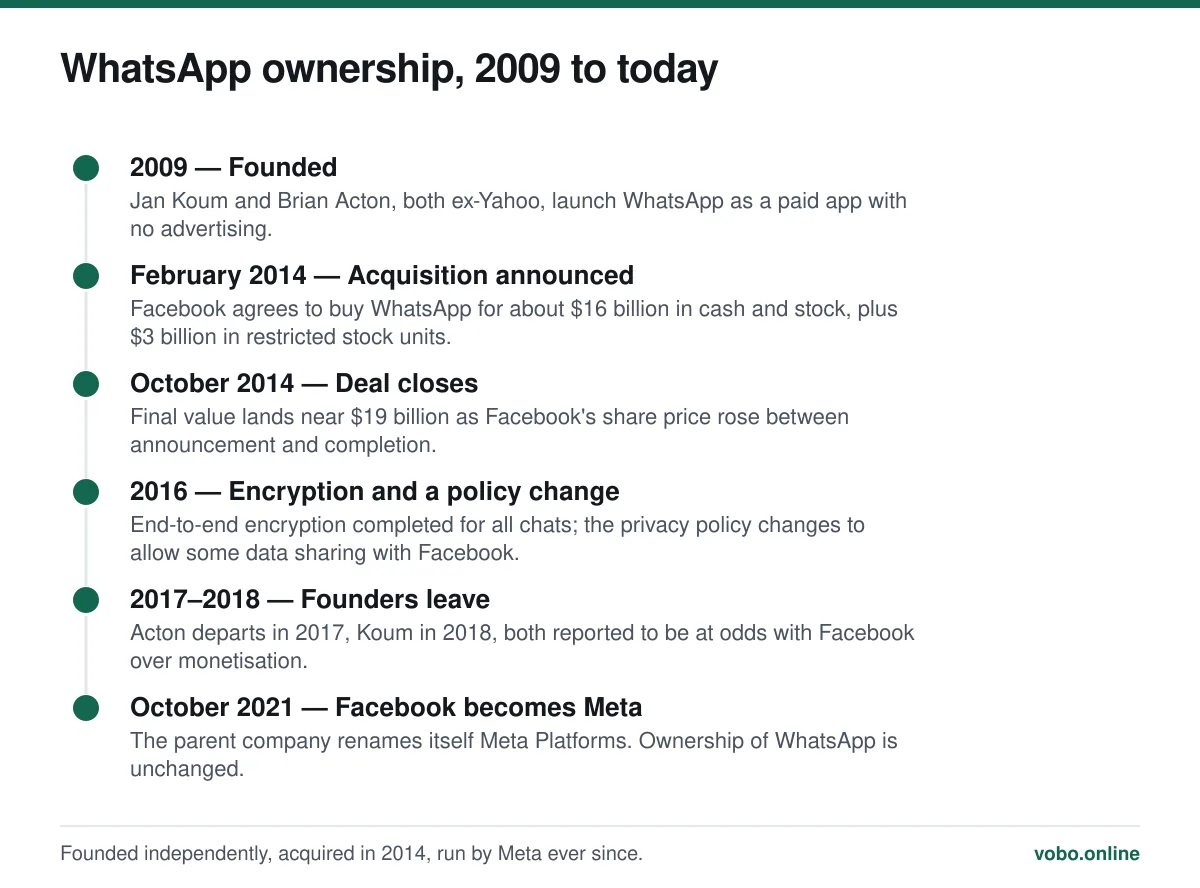
In February 2014, Facebook announced it was acquiring WhatsApp. The headline number at announcement was around $16 billion — $4 billion in cash and about $12 billion in Facebook shares — plus a further $3 billion in restricted stock units for founders and employees, vesting over four years.
Because a large part of the price was paid in Facebook stock, the final value moved with the share price between announcement and completion in October 2014. It closed at roughly $19 billion, which is the figure most commonly quoted. Both numbers are correct; they are measuring different moments.
At the time it was the largest acquisition of a venture-backed company on record, and the reaction was close to disbelief. WhatsApp had around 450 million monthly users and a workforce of about 55 people. It charged $0.99 a year in some markets, ran no advertising, and collected almost nothing about its users. Facebook was paying roughly $40 per user for a product that barely monetised.
The logic, in hindsight, was straightforward. WhatsApp was becoming the default communication layer in Europe, India and Latin America — markets where SMS was expensive and Facebook's own Messenger had not won. Buying it removed the only serious threat to Facebook's position in messaging worldwide.
Why the founders left
Jan Koum and Brian Acton built WhatsApp on an explicitly anti-advertising position. A note pinned to Koum's desk, widely reported at the time, read "No Ads! No Games! No Gimmicks!" The app charged a small annual fee precisely so it would not need to sell attention.
That position did not survive the acquisition. Acton left Facebook in September 2017, forfeiting a substantial amount of unvested stock, and later said publicly that he had disagreed with plans to monetise WhatsApp through advertising and to weaken encryption for commercial messaging. In March 2018, during the Cambridge Analytica period, he posted "It is time. #deletefacebook" — an unusual thing for someone who had sold his company to that firm three years earlier.
Koum announced his departure in April 2018 and left the Facebook board. Reporting at the time attributed the split to disputes over data privacy and the use of encryption. Neither founder has run the product since.
What changed for users after the acquisition
| Independent WhatsApp (2009–2014) | Under Meta (2014–today) | |
|---|---|---|
| Price | Free first year, then about $0.99 a year in some markets | Free everywhere; the subscription was dropped in 2016 |
| Advertising in chats | None, by stated policy | None in the chat list to date; ads appear in the Updates tab in some regions |
| Encryption | Added progressively from 2014 | End-to-end by default for all personal chats since 2016 |
| Data sharing with the parent | Not applicable | Account and usage metadata shared with Meta; message content is not |
| Business messaging | None | A core revenue line — companies pay to message customers |
| Who decides the roadmap | Two founders and a small team | Meta's product organisation |
The most consequential change was the 2016 privacy policy update, which began sharing some account information — your phone number, when you last used the service, device details — with Facebook, for purposes including ad targeting on Facebook itself. Existing users were given a 30-day window to opt out of part of it; new users were not offered that choice. European regulators objected, and the sharing for advertising purposes was suspended in the EU.
A second policy update in 2021 caused a much larger public reaction, and much of that reaction was based on a misreading. The change concerned messages sent to business accounts, not personal chats, and did not alter end-to-end encryption. WhatsApp handled the announcement badly enough that millions of people installed Signal and Telegram in the following weeks anyway.
Does Meta read your messages?
Not the content of personal messages. WhatsApp uses the Signal protocol, and personal chats, calls, media and status updates are end-to-end encrypted by default. The keys live on the devices. Meta's servers relay ciphertext they cannot decrypt, and that design has been examined in the peer-reviewed cryptographic literature rather than merely asserted in marketing material.
What Meta does hold is metadata, and metadata is not a trivial category. Your phone number, your device and IP address, when you are online, who you exchange messages with and how often, which groups you belong to, and your profile details are all visible to the company. A record of who you spoke to at 3am every night for a month reveals a great deal without a single message being read.
The practical boundary between what is protected and what is not is covered in more detail in is WhatsApp safe for private photos, and the specific question of who can see your phone number is answered in does WhatsApp show your phone number.
Can you separate your WhatsApp from Facebook?
Partly. If you have connected your WhatsApp to a Meta Accounts Center — which links it with Facebook and Instagram for shared logins and cross-posting — you can remove it again. That stops the account-level linkage. It does not stop the platform-level data collection described in WhatsApp's own privacy policy, because that is a condition of using the service at all.
The steps for unlinking, and an honest account of what it does and does not achieve, are in how to remove WhatsApp from Facebook.
If ownership is the deciding factor
Some people are not comfortable with a Meta-owned messenger regardless of the encryption. That is a coherent position, and the alternatives differ in exactly the way that matters here: Signal is run by a non-profit foundation funded by donations and holds famously little metadata; Telegram is owned by a private company and does not encrypt ordinary chats end-to-end by default at all, which surprises people who assume it is the more private option.
The practical obstacle is not features but reach. WhatsApp's value is that the people you need to contact are already on it, which is the same reason it was worth $19 billion in the first place. Why that network effect took hold in some countries and not others is the subject of why people use WhatsApp.
Frequently asked questions
Does Facebook still own WhatsApp?
Yes, under a different name. Facebook, Inc. renamed itself Meta Platforms, Inc. in October 2021. It is the same corporate entity and the same ownership; only the parent company's name changed. WhatsApp, Instagram, Messenger and Facebook are all Meta products.
How much did Facebook pay for WhatsApp?
About $19 billion by the time the deal closed in October 2014. The announcement in February 2014 was framed as roughly $16 billion — $4 billion cash plus around $12 billion in stock — with a further $3 billion in restricted stock units for the team. The final figure was higher because Facebook's share price rose in between.
Who founded WhatsApp?
Jan Koum and Brian Acton, both former Yahoo engineers, founded it in 2009. Koum, who grew up in Ukraine before emigrating to California, is generally credited with the original idea. Neither founder has been involved since 2018.
Is WhatsApp a Chinese or Indian company?
No. It is American, owned by Meta Platforms and headquartered in the United States. The confusion usually comes from India being WhatsApp's largest market by users, which says something about where the app is used rather than about who owns it.
Sources
- Facebook to Acquire WhatsApp — Meta Investor RelationsSupports: The February 2014 deal structure: $4bn cash, roughly $12bn in stock, plus $3bn in restricted stock units.
- Meta company information — MetaSupports: That Meta Platforms is the parent company of WhatsApp, Facebook, Instagram and Messenger, and the October 2021 renaming.
- WhatsApp Privacy Policy — WhatsApp LLCSupports: What information WhatsApp collects and shares with other Meta companies, and the distinction between message content and metadata.
Related reading
Privacy and security
How to remove WhatsApp from Facebook, and what it actually achieves
You can unlink WhatsApp from a Meta Accounts Center in a few taps. Here is how, and an honest account of what that does and does not stop.
Privacy and security
Does WhatsApp show your phone number, and to exactly whom?
Your number is your WhatsApp account, so anyone you message can see it. Here is precisely who sees it in chats, groups, communities and business accounts.
Features explained
Why do people use WhatsApp, and why not everywhere?
WhatsApp is dominant across Europe, India and Latin America and marginal in the US. The reason is SMS pricing history, not features.
Features explained
Is WhatsApp social media, or just a messaging app?
WhatsApp started as an SMS replacement and grew Status, Channels and Communities. Here is where the line sits and why the answer changed.