Why do people use WhatsApp, and why not everywhere?
WhatsApp won in countries where texting was expensive, which is most of the world. It made messages and international calls effectively free, worked identically on every phone, and arrived with your existing contacts already in it. It never took over in the United States because American carriers made domestic texting free early and iMessage filled the gap for iPhone users.
Key takeaways
- Cost was the driver. Where SMS was billed per message, a free alternative spread very fast.
- It is cross-platform, which mattered enormously outside the US where Android dominates.
- The phone book was the contact list — no friend requests, no usernames, no setup friction.
- Adoption is now self-reinforcing: people stay because everyone they need is already there.
The original reason: SMS was expensive
In most of the world through the 2000s, every text message cost money. Not much individually, but enough that people counted them, and international texts cost considerably more. Voice calls abroad were worse.
WhatsApp made that disappear. Because messages travel over the internet, there is no international rate and no per-message charge — a message to another continent costs the same as one across the room, which is a few bytes of data. For anyone with family abroad, that was not a convenience but a monthly saving.
This is the single largest factor and it is why adoption maps so closely onto migration patterns and onto mobile pricing history. The detail of what it costs today is in is WhatsApp free.
Why adoption is so uneven
| Region | Position | Why |
|---|---|---|
| India | Dominant; the largest user base in the world | Cheap Android phones, expensive SMS, and enormous internal migration |
| Brazil and Latin America | Dominant, including for business | Costly SMS, Android-heavy market, and carrier deals that zero-rated it |
| Western Europe | Dominant for personal messaging | Per-message SMS charges and heavy cross-border contact |
| Nigeria and much of Africa | Dominant | Data cheaper than SMS; Android-first market |
| United States | Minority, mostly for international contact | Unlimited texting arrived early; iMessage covered iPhone users |
| China | Blocked | Not available; WeChat occupies the space |
The American exception is the one people find most surprising, and it has a straightforward explanation. US carriers moved to unlimited domestic SMS bundles years before most of the world, so the cost problem WhatsApp solved had already gone away. Apple then shipped iMessage in 2011, which upgraded iPhone-to-iPhone messaging silently and for free. Between them, there was no gap left for WhatsApp to fill.
The features that made it stick
- It worked on every phone. In markets where most people are on Android and a minority on iPhone, a messenger that only works between iPhones is useless. WhatsApp was indifferent to the hardware.
- Your contacts were already there. No usernames, no friend requests, no search. Install it and the people you knew appeared, because the identifier was the number already in your phone book.
- Groups actually worked. SMS group messaging was poor everywhere and terrible on some phones. WhatsApp made a proper group object with names, admins and replies.
- Media arrived intact. MMS was expensive and unreliable; sending a photo on WhatsApp simply worked.
- Voice notes. Enormously popular in markets with lower typing literacy or scripts that are awkward on a keyboard, and now popular everywhere.
- It was light. WhatsApp ran acceptably on cheap phones and slow connections at a time when most apps did not.
Why people stay now
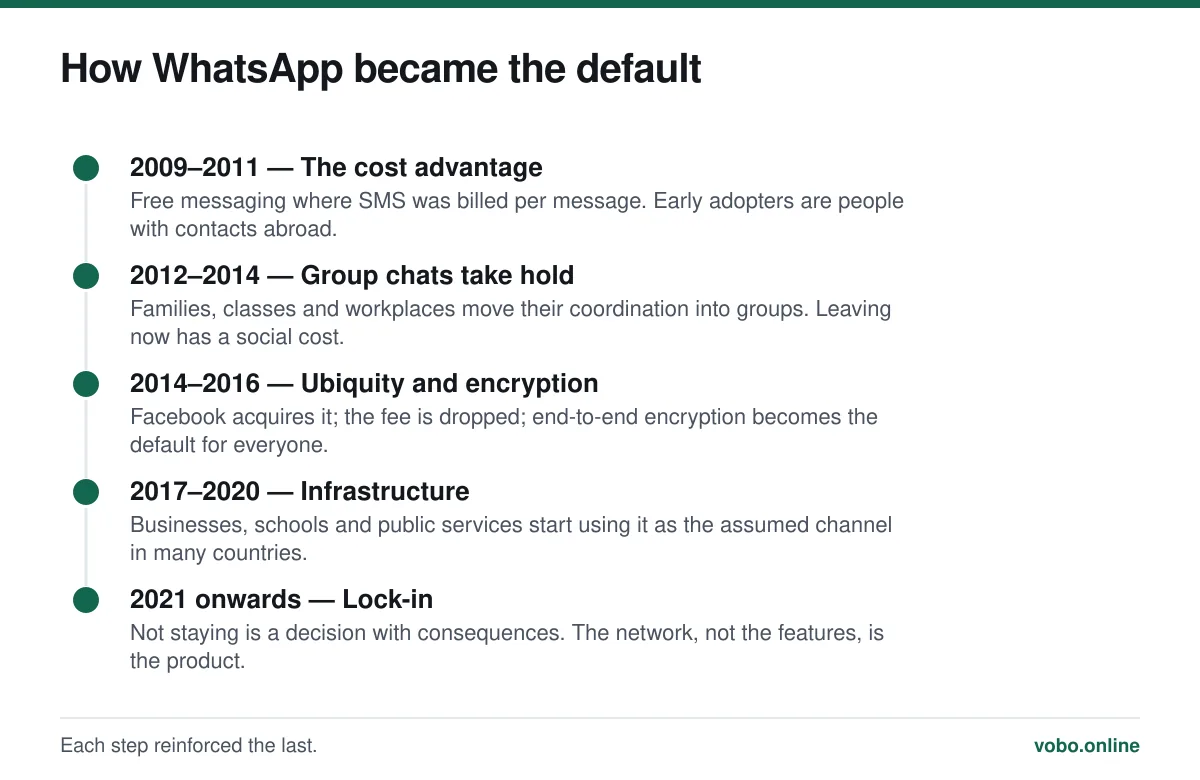
The reasons people join and the reasons they stay are no longer the same, and this is the part worth being clear-eyed about.
Nobody today chooses WhatsApp because international messaging is free — that is true of every messenger. They stay because the family group is there, the school announcements come through it, and the plumber replies on it. Switching is not a decision about an app; it is a request that thirty other people also switch.
The reasons people are uneasy about it
A fair account has to include these, because they are the reason a minority of users actively want out.
- Meta ownership. Message content is encrypted and unreadable to Meta, but metadata — who you talk to, when, from where — is not. Some people object to that on principle regardless of the encryption.
- Phone number exposure. Your number is visible to everyone in any group with you, and cannot be hidden. See does WhatsApp show your phone number.
- Misinformation in groups. Forwarded content spreads fast in large groups and is hard to correct, which has had documented real-world consequences in several countries.
- Social obligation. A messenger everybody uses becomes a channel it is difficult to be unavailable on.
Where it goes beyond personal messaging
In Brazil, India, Indonesia and much of the Middle East, WhatsApp is not only how people talk to each other but how they talk to businesses. Shops take orders on it, banks send alerts through it, and doctors' surgeries confirm appointments on it.
That is also where Meta's revenue comes from: businesses pay to message customers, consumers pay nothing. It is why the app has grown Channels and Communities and started to look less like a texting replacement, which raises the question covered in is WhatsApp social media.
Frequently asked questions
Why is WhatsApp so popular in Europe and India but not the US?
Because American carriers offered unlimited domestic texting early and iMessage covered iPhone users automatically, so the cost problem WhatsApp solved had already been solved. In Europe and India, per-message SMS charges and a heavily Android market left an obvious gap.
Is WhatsApp better than other messaging apps?
It depends what you are measuring. Signal holds less metadata; Telegram has more features but weaker default encryption; iMessage is smoother between Apple devices. WhatsApp's advantage is reach, and for most people reach is the feature that decides it.
How many people use WhatsApp?
Around two to three billion monthly users, making it the most used messaging app in the world. India is the largest single market by a wide margin. Figures vary by source and by how 'active' is defined, so treat any precise number with caution.
Why do people use WhatsApp instead of just texting?
Free international messaging, working group chats, reliable photo and video sending, voice notes, free calls and end-to-end encryption — none of which SMS offers. The full comparison is in our piece on WhatsApp versus texting.
Sources
- Social Media Fact Sheet — Pew Research CenterSupports: US adoption figures for messaging platforms, supporting the point that WhatsApp remains a minority channel in the United States.
- Digital News Report 2025 — Reuters Institute for the Study of JournalismSupports: Cross-country data on messaging app usage showing WhatsApp's dominance in Latin America, southern Europe and parts of Asia.
- Meta company information — MetaSupports: WhatsApp's ownership and its position within Meta's family of products, referenced in the network-effect section.
Related reading
Features explained
Why people use WhatsApp instead of texting
WhatsApp beat SMS on cost, groups, media and encryption. Here is a feature-by-feature comparison with SMS, RCS and iMessage, and where texting still wins.
Privacy and security
Who owns WhatsApp, and what that ownership actually means for you
Meta Platforms has owned WhatsApp since 2014, when Facebook paid about $19 billion for it. Here is how that happened and what changed for users afterwards.
Features explained
Is WhatsApp social media, or just a messaging app?
WhatsApp started as an SMS replacement and grew Status, Channels and Communities. Here is where the line sits and why the answer changed.
Calls, data and cost
Is WhatsApp free? Yes, and here is what it actually costs you
WhatsApp costs nothing to install or use, and has since 2016. The real costs are data, roaming and what Meta gets from your metadata.