Is WhatsApp social media, or just a messaging app?
It began as a private messaging app, which is not social media, and it has since grown features that are — Status, Channels and Communities all broadcast to an audience rather than to a person. The honest answer today is that WhatsApp is a messaging app with social media attached, and which label applies depends on whether you use those features.
Key takeaways
- Private chats are not social media: no feed, no public profile, no discovery, no algorithm.
- Status, Channels and Communities are broadcast features, and those genuinely are.
- The distinction matters practically — for workplace policies, for schools, and for regulation.
- You can use WhatsApp for years and never touch the parts that make it social media.
What separates the two
Definitions of social media vary, but the useful ones agree on a few properties: content is broadcast to an audience rather than sent to a person, there is a way to discover people you do not already know, profiles are public or semi-public, and something — an algorithm or a feed — decides what you see.
By that test, a WhatsApp chat is not social media in any sense. There is no feed. There is no discovery: you cannot search for people, and there is no directory. There is no algorithm choosing what you see, only chronological messages from people who already have your number. It is closer to a telephone than to Instagram.
| Property | Private chats | Status | Channels |
|---|---|---|---|
| Broadcast to an audience | No | Yes | Yes |
| Discover strangers | No | No | Yes — a directory exists |
| Public profile | No | No | Yes, for the channel |
| Algorithmic feed | No | No | Partly — recommendations exist |
| End-to-end encrypted | Yes | Yes | No, in the way personal chats are |
| Counts as social media? | No | Arguably | Yes |
The features that changed the answer
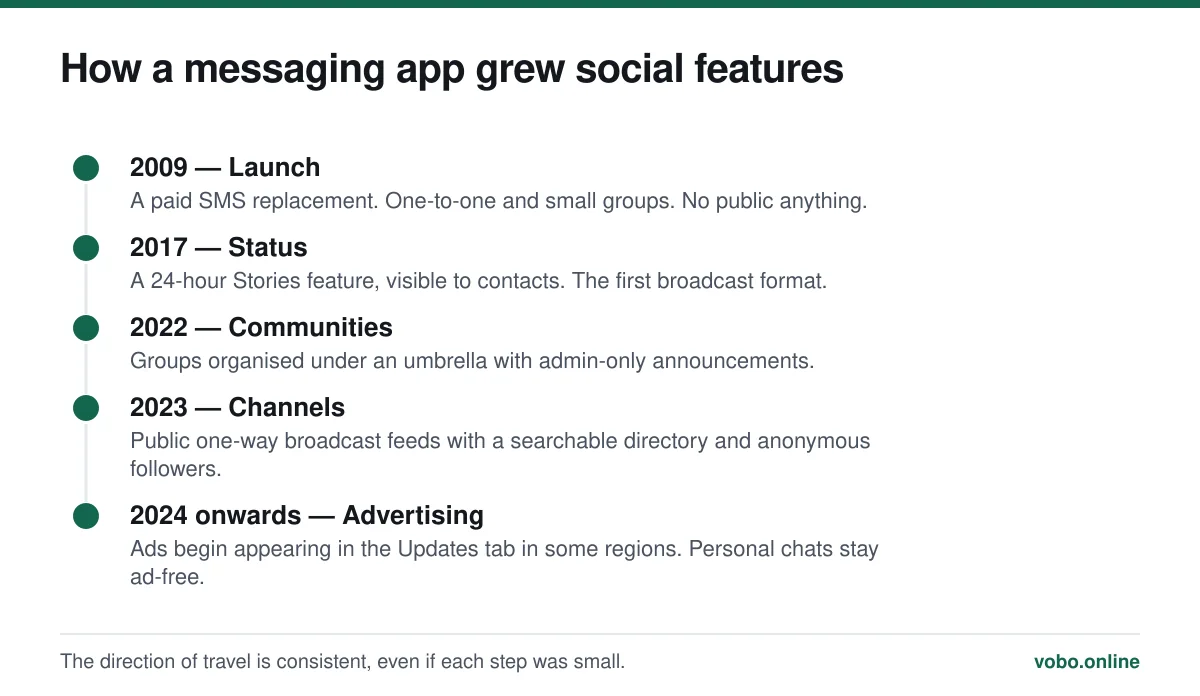
WhatsApp in 2014 was unambiguously not social media. Three additions since then moved it.
- Status, added in 2017. Photos and videos posted to your contacts that vanish after 24 hours — a Stories feature, which is a social media format regardless of who can see it. It is still limited to your contacts, which keeps it closer to broadcasting to a group than publishing.
- Communities, added in 2022. Umbrella structures linking related groups with an admin-only announcement channel. This is closer to a forum or an organisation's noticeboard than to a conversation.
- Channels, added in 2023. One-way broadcast feeds where an admin posts and followers read. Followers are anonymous to each other, cannot reply, and find channels through a searchable directory. This is unambiguously a publishing platform, and it is where advertising has started to appear.
Why the label has practical consequences
This is not a definitional argument for its own sake. Several real decisions turn on it.
- Workplace and school policies. A rule banning social media during working hours may or may not cover a message to a colleague. Most policies are written without anyone having thought about it.
- Regulation. Online safety legislation in the UK and EU treats private messaging and public content services differently, and where WhatsApp sits affects which obligations apply to which features.
- Screen-time and parental controls. Tools that block social media categories may or may not block WhatsApp, and often do so inconsistently.
- Research and statistics. Surveys about social media use produce very different figures depending on whether WhatsApp is counted, which is why comparisons across studies are often not comparable.
The privacy difference is real
Whatever label you use, the underlying properties differ sharply between the two halves of the app, and those properties are what actually matter.
Personal chats are end-to-end encrypted, cannot be seen by Meta, and reach only the people you send them to. Channels are not encrypted in that way — a public broadcast has no meaningful secret to keep — and are visible to the platform. Status sits in between: encrypted, but posted to an audience rather than a person.
What Meta can and cannot see across all of this is set out in who owns WhatsApp, and the specific limits of the encryption are covered in can WhatsApp be hacked.
Using WhatsApp without the social media parts
Entirely possible, and many people already do it without noticing. The broadcast features are opt-in.
- Do not follow any channels. The Updates tab then holds only status updates from contacts.
- Restrict who sees your status: Settings → Privacy → Status, where you can limit it to a chosen list or exclude specific people.
- Do not post status updates at all, which is the default state.
- Leave communities you have been added to. They function as groups, so leaving works the same way.
With those four things, WhatsApp behaves exactly as it did in 2014: a private messaging app with no feed and no audience. The privacy settings that govern all of this are covered in how to hide your phone number on WhatsApp, which walks through the full Privacy screen.
Frequently asked questions
Is WhatsApp considered social media?
Partly. Private chats are not — there is no feed, no discovery and no public profile. Status, Communities and especially Channels are broadcast features that do meet the usual definition. Which answer applies depends on which parts of the app you use.
Is WhatsApp the same as Facebook?
Same owner, different product. Meta Platforms owns both. WhatsApp has no public profiles, no news feed and no algorithmic timeline in its messaging, and personal chats are end-to-end encrypted in a way Facebook posts are not.
Does WhatsApp have an algorithm?
Not for your chats, which are strictly chronological. Channel recommendations in the Updates tab do involve ranking, so the social media half of the app has algorithmic elements while the messaging half does not.
Do school and workplace social media bans cover WhatsApp?
It depends entirely on how the policy is written, and most are written without addressing it. Policies aimed at feeds and public posting often do not fit private messaging; policies aimed at distraction usually intend to include it.
Sources
- About WhatsApp Channels — WhatsApp Help CenterSupports: That Channels are one-way broadcast feeds with a directory and anonymous followers, and are not encrypted as personal chats are.
- About WhatsApp Communities — WhatsApp Help CenterSupports: The structure of Communities and their admin-only announcement groups.
- Social Media Fact Sheet — Pew Research CenterSupports: That major survey research counts WhatsApp among social media platforms, which affects how usage statistics compare.
Related reading
Features explained
Why do people use WhatsApp, and why not everywhere?
WhatsApp is dominant across Europe, India and Latin America and marginal in the US. The reason is SMS pricing history, not features.
Privacy and security
Who owns WhatsApp, and what that ownership actually means for you
Meta Platforms has owned WhatsApp since 2014, when Facebook paid about $19 billion for it. Here is how that happened and what changed for users afterwards.
Features explained
Why people use WhatsApp instead of texting
WhatsApp beat SMS on cost, groups, media and encryption. Here is a feature-by-feature comparison with SMS, RCS and iMessage, and where texting still wins.
Privacy and security
How to hide your phone number on WhatsApp — and what you actually can hide
You cannot hide your number from someone you message, but you can control almost everything else. Here is what works, what does not, and the second-number option.